
Moderating reviews
Decide which reviews go on your storefront, reply to them, and deal with the ones that shouldn't be public.
Work the queue
- Open Reviews and filter to Needs review. Narrow by rating, product or date if the list is long, and save a filter you use every day as a quick filter. See Filtering.
- Click a review to open it on its own page, and choose Publish or Reject at the top. Publishing puts it on your storefront and counts it in the product's rating. Rejecting keeps it off and keeps it in Meisei, and asks you why first (see below). Both can be undone later.
- Click Reviews at the top of the page to go back to the list, with your filter and search as you left them.
- After an import or a busy weekend, select several rows and publish or reject them together. Rejecting a selection asks for one reason that covers all of them.
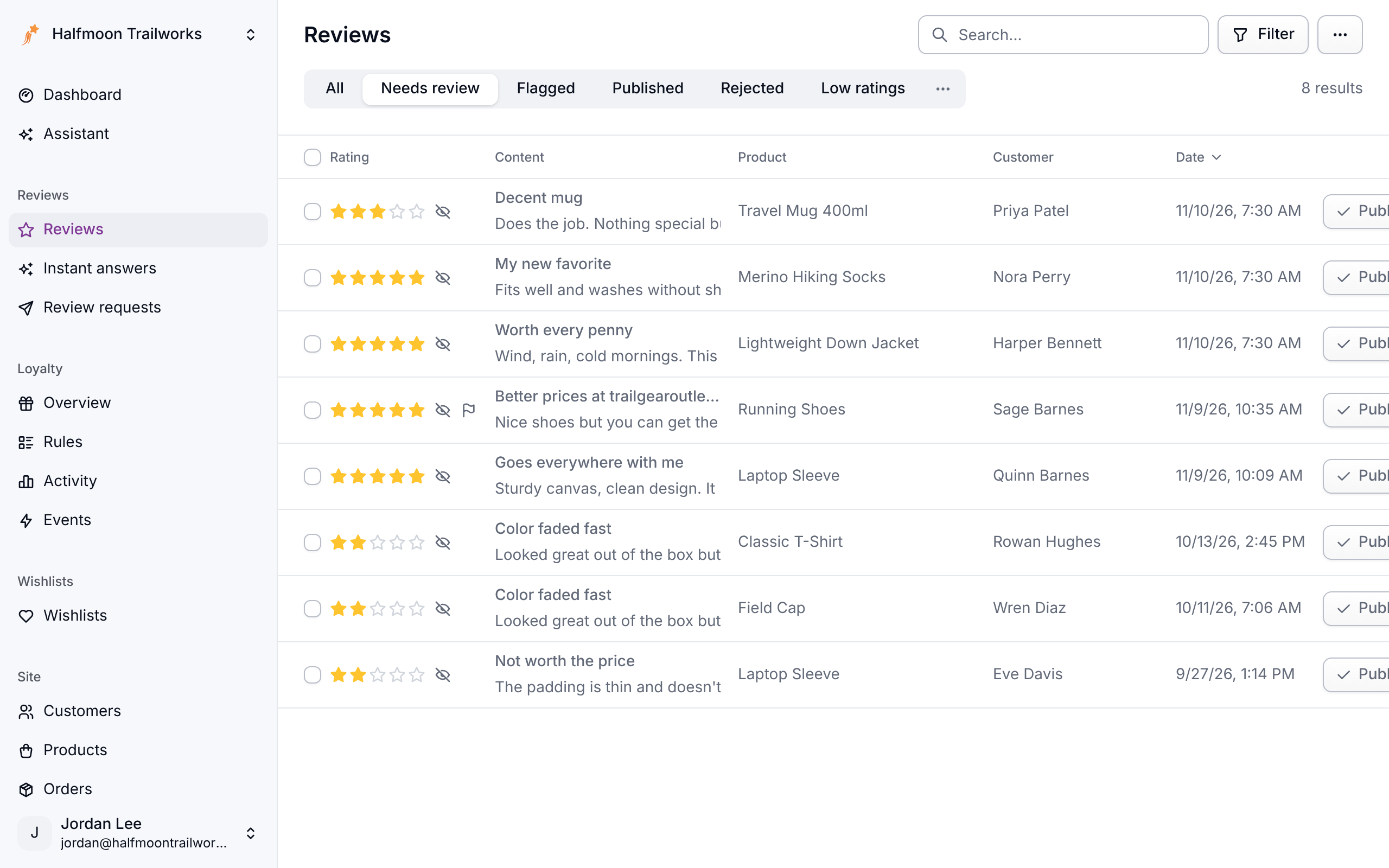
A review is in one of four states: waiting for moderation, published, rejected, or flagged because content screening caught something or a shopper reported it.
If most of what you get is fine, turn on Automatically publish new reviews under Settings → Features → Reviews. Reviews of every star rating then go live on arrival, and only the ones screening flags wait for you. See Reviews.
Say why a review comes down
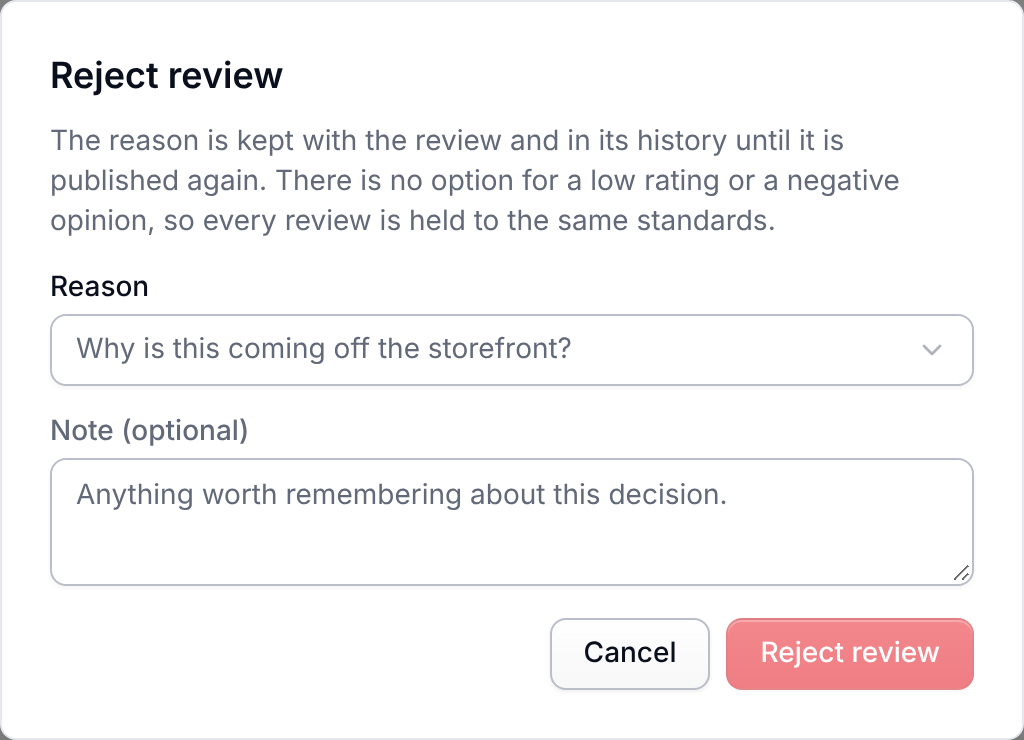
Rejecting a review, or unpublishing one that was live, asks for a reason first:
- The reviewer asked for it to be taken down
- Spam
- Abusive or inappropriate content
- Not about this product
- Duplicate
- Test data
- Written by staff or someone with a stake in your business
- Changed by the reviewer after it was published, and waiting for another look
- Other, with a note saying what happened
There's deliberately no reason for a low rating or a negative opinion. Hold every review to the same standards whatever its stars, and publish the honest one-star reviews alongside the five-star ones.
The reason shows on the review's page and in the list's Reason filter, and stays until the review is published again. The review's history also keeps every publish, unpublish and rejection with who made it and why, including the ones made by an automation, an AI assistant or another app. Months later, you can still show why a review isn't on your storefront.
Reviews that screening holds back, or that a reviewer's edit sends back to the queue, wait for you without a reason, because nobody has decided anything yet.
For developers: taking a review down through the API needs a reason too, which an older integration won't be sending. See the Reviews API reference.
Read before you decide
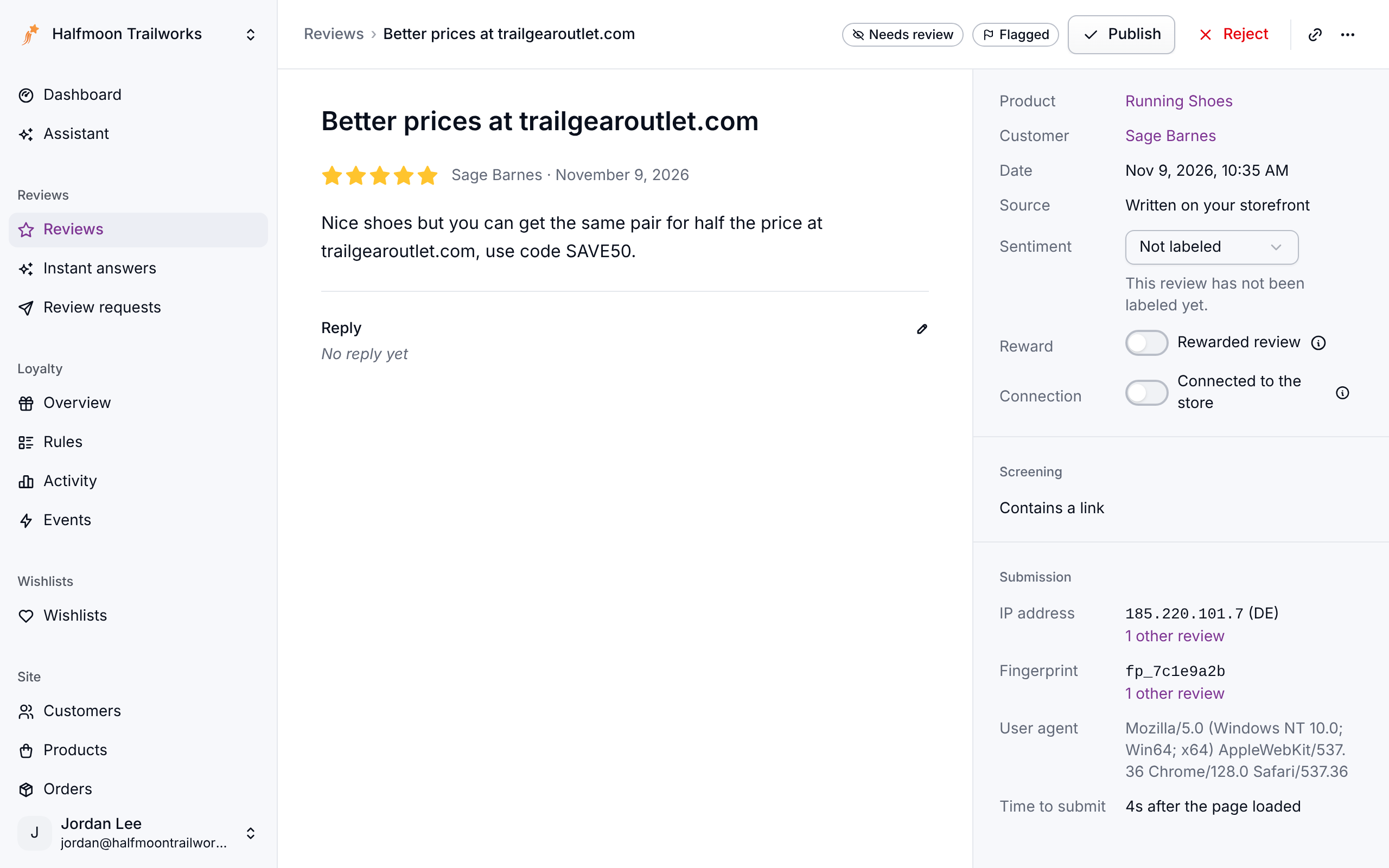
A review's page has the text, rating and anything the reviewer attached in the main column. Beside them it shows:
- The product and the customer, with a link to each.
- Where it came from: a review request, your storefront, or another app, whose Verified buyer badge Meisei didn't check.
- Their answers to your review questions, including questions you've since archived.
- Photos and videos. They aren't visible on your store until you publish the review, so look at them first, especially on a review whose text is unremarkable. If screening flagged one, they stay hidden until you choose Show attachments.
- Why it was flagged, when screening caught something.
- What shoppers said when they reported it, under Reports from shoppers.
- How long the review took to write. Four seconds was probably not a person.
- A link to other reviews from the same browser or connection, when there are any. One browser reviewing as several customers is the clearest sign of a fake review.
Deal with reported reviews
Every review in the reviews widget has a small Report link. A shopper picks a reason (looks fake, offensive or abusive, shares someone's private information, not about this product, or something else) and can add a note. A report never takes a review down by itself. The review stays published until you decide.
- Open Reviews and choose the Flagged quick filter. A reported review is flagged, and the flag says how many shoppers reported it and why.
- Open the review and read Reports from shoppers: each reason and note, newest first.
- Choose Keep published if the review is fine, or Unpublish if it shouldn't be on your storefront. Either one marks the reports resolved and takes the flag off.
A shopper who reports the same review twice is counted once, with their latest reason. If they report it again after you've decided, it comes back as a new report.
Reply to a review
Open the review and write your reply. It appears under the review on your storefront, headed "Response from" the name you replied as. You can save it as a draft and publish it later. A draft never reaches your storefront. Each review holds one reply, which you can edit or delete afterward.
When you follow up on a low rating, fix the problem and never ask the customer to change or remove their review. See Keeping your reviews trustworthy.
Remove part of a review
Redacting removes a phone number, an order number, a staff member's name, or anything else
that shouldn't be public, and keeps the rest of the review. Select the text and save the
redaction. Meisei keeps the original privately so you can reverse it. Your storefront only
shows the redacted version. Redact is in the ... menu at the top right of the review.
Mark a rewarded review
When a customer earns something for writing a review, such as loyalty points or a discount code, your storefront shows Rewarded review beside the review, so shoppers can tell which reviews were rewarded. Consumer rules in several countries expect a reward for a review to be disclosed, and this label discloses it.
- Loyalty points for reviews marks each review it rewards for you. See Automations.
- For a reward you gave some other way, open the review and turn on Rewarded review. Turn it off again if you marked one by mistake. It changes the label only, not whether the review is published.
- To see every rewarded review, filter the list by Rewarded.
Mark a reviewer connected to your store
When someone who works for your store reviews it, or someone otherwise connected to it such as a relative of a staff member, your storefront can show Connected to the store beside the review, so shoppers know who wrote it. Consumer rules in several countries expect that connection to be disclosed.
- Open the review and turn on Connected to the store. Turn it off again if you marked one by mistake. It changes the label only, not whether the review is published.
- When a review comes in from an email address on a domain you've verified under Settings → URLs & domains, Meisei flags it and holds it for you. The reason reads "Email address is on your domain", followed by the domain. Meisei never turns the label on for you, because only you know whether the reviewer is connected. See Use your own domain for verifying a domain.
- To see every review you've marked, filter the list by Connection.
Delete a review
Delete is in the same ... menu. Deleting is permanent, so Meisei asks for a reason (spam, duplicate, test data, the
customer asked, and so on) and an optional note. The reason and who deleted it are kept, so
you can answer "why did that review disappear?" months later.
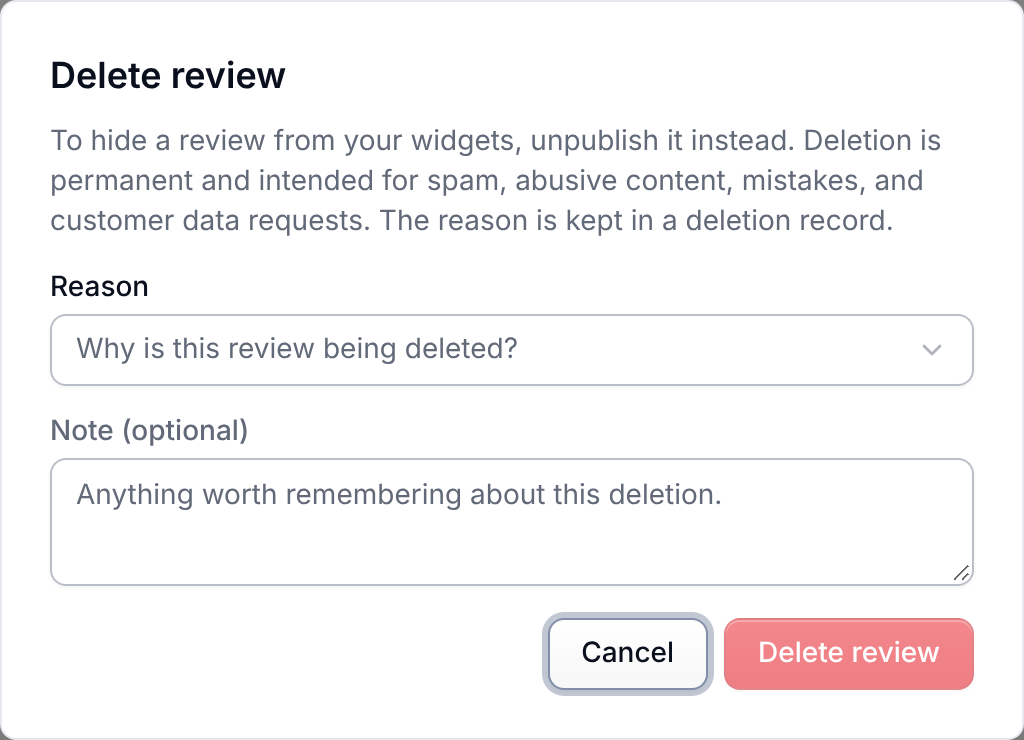
Prefer rejecting to deleting. Reject a review that shouldn't be on your storefront; delete one that shouldn't exist anywhere, or that a customer has asked you to remove. The reasons are the same either way, and neither has one for a low rating.
Hear about reviews as they arrive
Under Settings → Features → Reviews, choose alerts as reviews arrive, a daily summary email, or both. A common setup is an alert for 1 and 2 stars and the daily summary for everything else. See Reviews, or Sending Meisei to Slack to post them into a channel instead.
Spot fake reviews
The signals worth reacting to, roughly in order:
- One browser, several customers.
- A review written in seconds.
- Links in the review. Turn on the link flag and let screening catch these.
- Not a verified buyer, on a store where nearly all reviews are.
- A burst of similar reviews on one product in a short window.
- Text flagged as AI-written on a longer review. Read it first: a flag is not proof, and it's likelier on reviews by people whose first language isn't English.
- Shoppers reporting it as fake. See Deal with reported reviews.
AI screening catches fake reviews that these signals miss. See AI features.
A review's IP address, fingerprint and browser are personal data, so Meisei keeps them only as long as they help you moderate. They're cleared 90 days after you publish or reject the review, or 90 days after it arrived if nobody did, so use them while the review is recent. The country, the time it took to write and any flag they raised stay with the review.
Check that rejections don't follow the rating
Reject a review for what it says (spam, abuse, private details, nothing to do with the product), not for how many stars it gave. Shoppers trust a rating that includes the unhappy reviews, and hiding reviews because they're negative can mislead them. It's also easy to drift into without noticing, especially when someone else moderates for you.
The Rejections by rating chart on the Reviews dashboard shows the last 90 days of reviews by star rating, split into published, rejected and still waiting. Open Dashboard and switch to Reviews to see it.
A warning appears under the chart when both of these are true:
- 1 and 2 star reviews were rejected at least twice as often as 4 and 5 star reviews.
- At least five 1 or 2 star reviews were rejected.
Only reviews you've decided on count, so reviews still waiting are left out, and so are 3 star reviews. If the warning shows:
- Open Reviews, pick the Rejected quick filter, and sort by rating.
- Reread the low ones. Publish any you rejected only because they were critical.
- If someone else moderates for you, share this section with them.
Next steps
- Tune what publishes on its own: Reviews.
- Answer shoppers from your reviews: AI features.
- Keep your reviews honest: Keeping your reviews trustworthy.
- See how your ratings are trending: Analytics.