
Email template fields
Reference for the placeholders and layout blocks you can put in an
email template. Templates use Mustache
syntax: write a field as {{field}} and it is replaced with the real value when the email
is sent. A field the email has nothing to say about is empty, so wrap anything optional in
a section ({{#field}}...{{/field}}) to keep it out of the email.
The editor's Insert field button lists the fields on this page, apart from the loyalty fields, and drops one into the template at the cursor. It also lists wishlist fields, which only the wishlist alert emails fill.
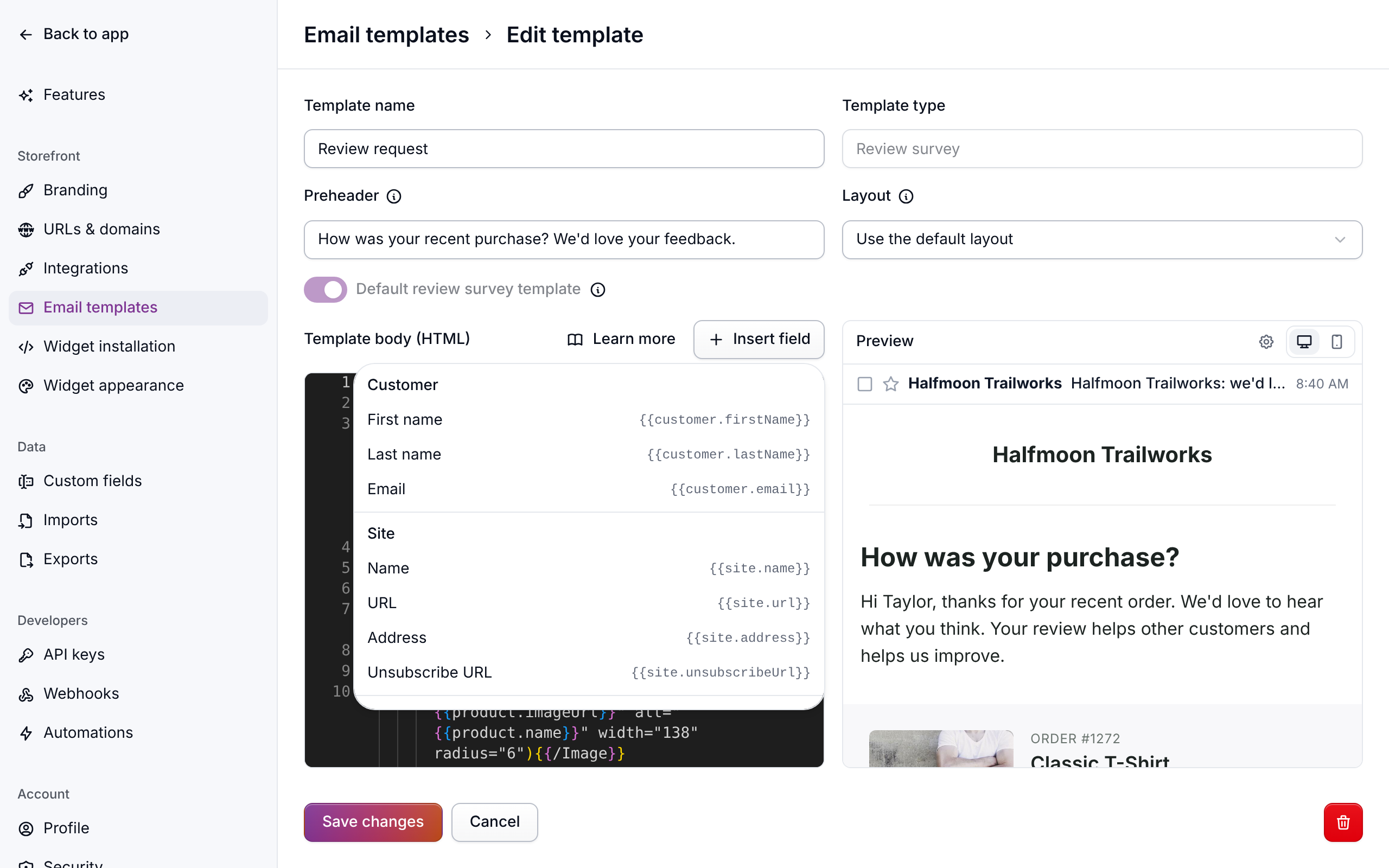
Customer
Site
The site's colors come from its branding, so a template that uses them follows the store's look rather than fixing its own:
{{site.logoUrl}} is empty when the site has no logo, so wrap it:
{{#site.logoUrl}}<img src="{{site.logoUrl}}" alt="{{site.name}}">{{/site.logoUrl}}.
{{site.unsubscribeUrl}} is a per-customer link where they can stop receiving marketing
email and opt back in. The default layout's footer renders it inside a {{#site.unsubscribeUrl}}
section so it disappears from previews and from mail with no recipient to unsubscribe.
Leave it in place.
Order
The review request carries every order field. A loyalty email sent for points an order
earned carries {{order.number}}, {{order.date}} and {{product.name}} for that order,
and is empty for them otherwise. The other emails have no order.
{{order.reviewUrl}} opens the review form for the order's first item and already carries
a query string, so add extra parameters with &. The star links in the default review
survey use {{order.reviewUrl}}&rating=1 to preselect a rating.
{{order.otherItems}} repeats for every item after the first, with {{title}} and
{{reviewUrl}} inside it. {{order.hasOtherItems}} wraps anything that should only appear
when the order has more than one item:
{{order.items}} is the same list with the first item included, with {{title}},
{{imageUrl}} and {{reviewUrl}} inside. The guided reviews setup writes this when you
pick "List every product equally":
Product
These describe the order's first item, the one {{order.reviewUrl}} links to.
Loyalty
These are filled in the loyalty member emails, which you edit on the
Loyalty member emails automation rather than here. A points-earned email for an order also
fills {{order.number}}, {{order.date}} and {{product.name}}.
- Points amounts arrive already written in your program's own words ("1,200 stars"), so
don't add a unit after them.
{{loyalty.pointsName}}is the plural name on its own, for "Spend your {{loyalty.pointsName}}". {{loyalty.reward.name}}is the name of the rule the reward came from, as the member saw it.{{loyalty.reward.cost}}is what they spent, empty for a reward they didn't pay for.- The expiry fields are filled only on the two expiring emails:
amountis what goes (points only),dayscounts whole days from now,whensays it in words ("today", "tomorrow" or "in 7 days"), anddateis the day in your store's time zone. {{loyalty.dashboardUrl}}and{{loyalty.redeemUrl}}open the loyalty page you set under Settings → Features → Loyalty, or your store's homepage if you set none. Both carry#meisei-rewards, which opens the loyalty widget on arrival. A shopper who isn't signed in sees what the program offers rather than their own balance, so put the member's numbers in the email itself.
Layout components
Components are layout blocks written as Mustache sections with parameters in parentheses.
Row wraps content in a full-width row, and Column creates a column within it. width
is the column's share of the row: 1, 1/2, 1/3, 2/3, 1/4 or 3/4. Columns sit side
by side on a computer and stack on a phone. Add sm with a share to keep a column side by
side on a phone too, as the image beside a product's details does:
Heading is the email's title (color, align), and Image a picture that shrinks
to fit its column (src, alt, width in pixels, radius for rounded corners, href to
make it a link):
Button is a styled button (href, backgroundColor, textColor,
borderRadius in pixels):
Label is a small uppercase caption (color), and Stat a big figure with a label
over it (label, labelColor, color, fontSize). Code puts a reward code in a dashed
box (border, color), and Divider draws a thin line (color):
Badge is an inline label (bgcolor), and Callout a highlighted block
(bgcolor, padding as a CSS value):
Layout
These three are only for a layout. The other fields on this page work in a layout too, but a layout is shared by every type, so a field that only one email has (an order, a reward) will be empty in the others.
{{{email.content}}} and {{{email.preheader}}} take three braces because they arrive already filled in, and three braces insert them unchanged. {{email.reason}}
finishes the footer's "You're receiving this because" sentence, for example "you made a
purchase at".